NFAA
· 3 min read
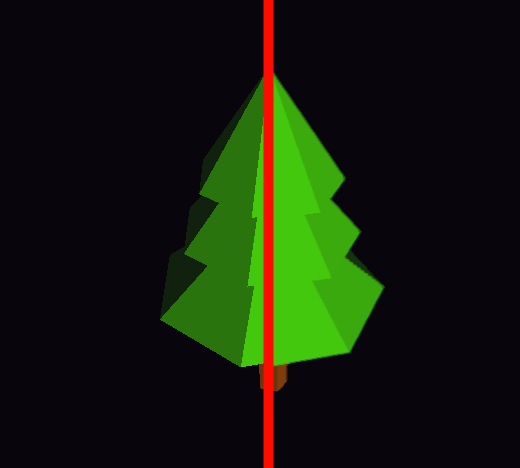
Added post processing anti aliaising. Still tweaking it a bit.
The idea behind this shader: NFAA
Update:
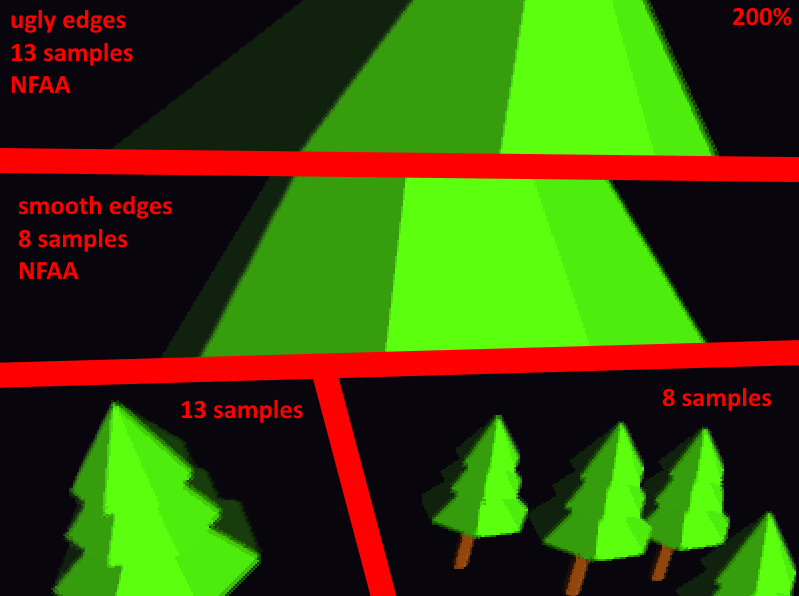
Some improvements with less samples per pixel:
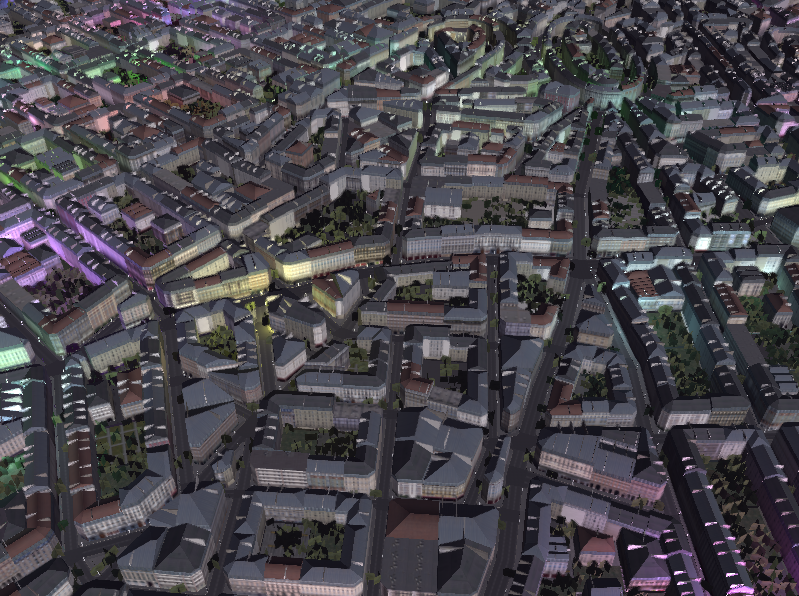
And here is a rather high freqency image but with low color luminance varianc:
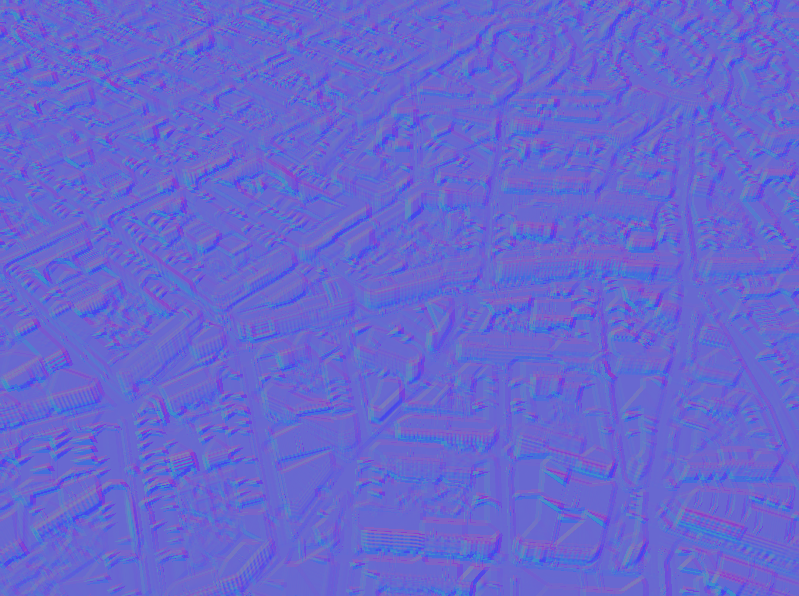
And here is the same scene but with the edges detected:
Update #2:
I went back to the 13 pixel lookups because testing only horizontal and vertical pixel differences caused on some "edge"-conditions no smoothing at all... Here's my shader if anybody is interessted (Fragment shader):
#version 400
//the final image buffer we want to smooth
uniform sampler2D l_tex;
uniform vec2 win_size;

//the output buffer
layout( location = 0 ) out vec4 def_e;

//the spread of the edge detection algorithm
const float fScale = 3.0f;

float GetColorLuminance( vec3 i_vColor )
{
  return dot( i_vColor, vec3( 0.2126f, 0.7152f, 0.0722f ) );
}

void main () {

  vec2 st;
  st.s = gl_FragCoord.x / win_size.x;
  st.t = gl_FragCoord.y / win_size.y;

  vec2 vPixelViewport = vec2( 1.0f / win_size.x, 1.0f / win_size.y );

  // Offset coordinates
  vec2 upOffset = vec2( 0.0f , vPixelViewport.y ) * fScale;
  vec2 rightOffset = vec2( vPixelViewport.x, 0.0f ) * fScale;

  float topHeight = GetColorLuminance( texture( l_tex, st + upOffset).rgb );
  float bottomHeight = GetColorLuminance( texture( l_tex, st - upOffset).rgb );
  float rightHeight = GetColorLuminance( texture( l_tex, st + rightOffset).rgb );
  float leftHeight = GetColorLuminance( texture( l_tex, st - rightOffset).rgb );

  float leftTopHeight = GetColorLuminance( texture( l_tex, st - rightOffset + upOffset).rgb );
  float leftBottomHeight = GetColorLuminance( texture( l_tex, st - rightOffset - upOffset).rgb );
  float rightBottomHeight = GetColorLuminance( texture( l_tex, st + rightOffset + upOffset).rgb );
  float rightTopHeight = GetColorLuminance( texture( l_tex, st + rightOffset - upOffset).rgb );

  // Normal map creation
  float sum0 = rightTopHeight+ topHeight + rightBottomHeight;
  float sum1 = leftTopHeight + bottomHeight + leftBottomHeight;
  float sum2 = leftTopHeight + leftHeight + rightTopHeight;
  float sum3 = leftBottomHeight + rightHeight + rightBottomHeight;

  float vector1 = (sum1 - sum0);
  float vector2 = (sum2 - sum3);

  //for horizontal and vertical only...
  //float vector1 = -(topHeight - bottomHeight);
  //float vector2 = rightHeight - leftHeight;

  vec3 Scene0 = texture( l_tex, st ).rgb;

  if(abs(vector1) < 0.0001 || abs(vector2) < 0.0001){
    //we don't need to smooth ...
    def_e.rgb = Scene0;
  }
  else{
    // Put them together and scale.
    vec2 Normal = vec2( vector2, vector1);
    Normal.xy = clamp(Normal,vec2(-1.0,-1.0)*0.4,vec2(1.0,1.0)*0.4); //Prevent over-blurring in high-contrast areas! -venzon
    vec2 final_norm = Normal * vPixelViewport * fScale;  // Increase pixel size to get more blur

    vec3 Scene1 = texture( l_tex, st + final_norm.xy ).rgb;
    vec3 Scene2 = texture( l_tex, st - final_norm.xy ).rgb;
    vec3 Scene3 = texture( l_tex, st + vec2(final_norm.x, -final_norm.y) * 0.5f ).rgb;
    vec3 Scene4 = texture( l_tex, st - vec2(final_norm.x, -final_norm.y) * 0.5f ).rgb;

    //Final color smoothed
    def_e.rgb = (Scene0 + Scene1 + Scene2 + Scene3 + Scene4) * 0.2;
    //show the normals of the smooth pixels
    //def_e.rgb = normalize( vec3(Normal.x, Normal.y , 1.0f ) * 0.5f + 0.5f);
    //show  pixels where the smoothing is applied to
    //def_e.rgb = vec3(1.0,0.0,0.0);
  }
  def_e.a = 1.0f;
}